
Gaskets
Seals that fill the space between two or more mating surfaces to prevent leakage from or into the joined objects under compression.
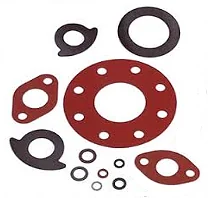
A gasket is a seal which fills the space between two or more mating surfaces, generally to prevent leakage from or into the joined objects while under compression.
Commonly produced by cutting from sheet materials, gaskets have the ability to fill and seal irregular or imperfect mating surfaces.
Typically gaskets are made from malleable materials in order to deform and fill the specified gland space (and account for surface irregularities). Some gaskets require an application of sealant applied directly to the gasket surface to function properly. Gaskets may also have a sealant applied to the material, such as a pressure sensitive adhesive backing. The user then simply peels away the liner and sticks the gasket into place.
Gaskets are normally cut from a flat sheet material but can also be compression molded. Commonly used materials include: paper; metal; cork; felt; plastic; neoprene, nitrile, silicone and fluorocarbon elastomers; and polytetrafluoroethylene — often referred to as PTFE or Teflon (DuPont).
Next step
Tell us what you need to seal
Send a part number, a drawing, or just a description of the application. Someone who knows seals will get back to you — usually the same day.